


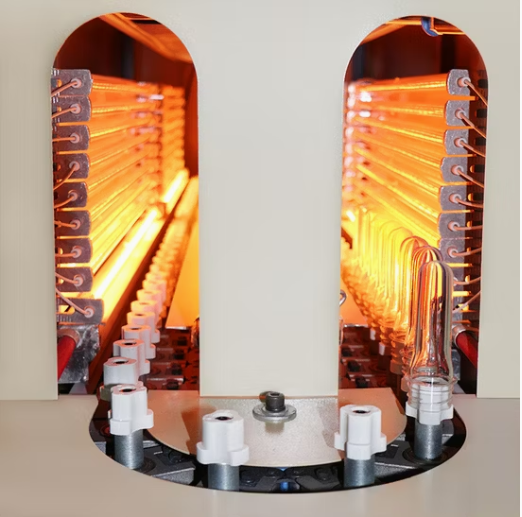
Getting the Heat Right in High-Speed PET Blowing
If you’re running a Sidel SBO6 or a Husky HyPET, you already know that throwing more wattage at the problem isn’t the answer. It’s not about raw power. It’s about getting that heat to actually soak into the core of the preform without burning the outside to a crisp. That’s exactly why we built our lamps the way we did.
The trick to deeper heating
We lean heavily on short-wave infrared. Why? Because it pushes heat deeper into the PET. By tweaking the tungsten filament density and using ultra-pure quartz, we can crank up the radiation intensity. The result? The heat punches through those thicker preform walls a lot faster. But you have to walk a fine line with voltage and wattage. Get it too low, and you’ll find annoying cold spots in the base of your bottles. Go too high, and you’re risking a melted neck ring. We make sure our tubes match your original machine footprint perfectly. You just pop them in. No rewiring, no headaches.
Built for the grind
These things live in a brutal environment. That’s why we use high-grade quartz glass—it can handle the shock of rapid heating and cooling without cracking. And we didn’t skimp on the connectors. Whether you use R7s or SK15, they’re built to survive constant vibration. A loose connection is a nightmare; it leads to arcing, and then your lamp burns out way before it should. We also add specific coatings to the quartz. This shifts the spectral output so the PET resin actually absorbs the energy instead of just bouncing it off the surface.
A quick word of caution
Here’s the thing: higher heat density means you can run your cycles faster. That’s great for production. But there’s a catch. High-output lamps put a lot more stress on your oven’s ventilation. You’ve got to keep your cooling blowers clean. If the airflow gets choked, the oven temperature climbs too high. Before you know it, your preforms are warping before they even hit the blow stage. Keep the air moving, and these lamps will do the heavy lifting for you.